
Part 1: The Hidden Formula Behind Every Growing Brand (and Why Most Marketers Miss It)
Discover the 3 true sources of brand growth - penetration, usage, and value - and learn how to balance "safe" strategies with bold moves that drive results.
Boon Han Soon
9/22/20255 min read
The Simple Equation That Explains Brand Growth
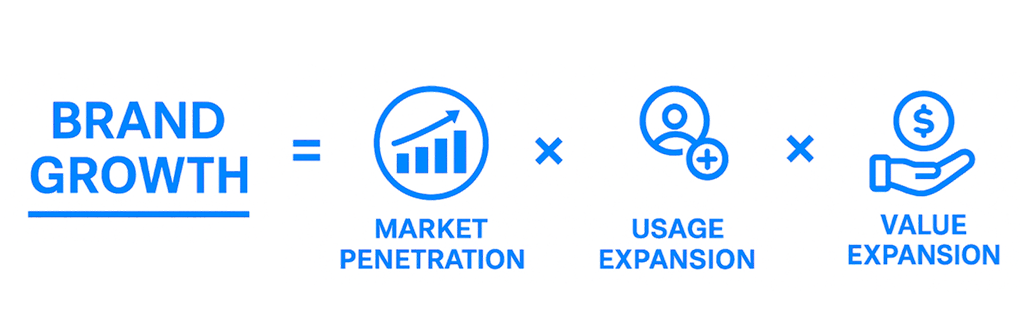
If you've ever stared at a brand P&L trying to make sense of what really drives the numbers, you're not alone. Most marketers juggle campaign reports, media spends, and sales data, but rarely do they see the full picture. Yet, the formula that explains brand growth is surprisingly simple:
Brand Growth = Market Penetration × Usage Expansion × Value Expansion
That's it. Everything your brand does - every promotion, campaign, or product tweak - ties back to one of these three levers. If it doesn't, it's not really driving growth. The problem is, most marketers never consciously frame their strategies around this formula. They run ads, launch new SKUs, or refresh packaging, without mapping how each action links to penetration, usage, or value.
Understanding this formula transforms how you see your marketing efforts. It turns "activities" into measurable growth levers. Once you see this, you'll stop treating marketing like art and start treating it like strategy. You'll realize every brand has only three real ways to grow, and market research is what helps you know which one to pull.
What Market Penetration Really Means (and Why It's Often Overlooked)
Market penetration is simply how many people buy your brand out of the total potential buyers in your category. Think of it as your brand's reach, not in media terms, but in real households and shoppers. The truth is, most brand growth comes not from loyal customers buying more, but from new customers buying once.
Byron Sharp's How Brands Grow popularized this truth - that "light buyers" make up the majority of your volume. Even small increases in penetration can have massive effects. So, if you're obsessing over loyalty programs but not expanding your customer base, you're missing the real growth driver.
Here's where market research steps in. Consumer panel data (from NielsenIQ or Kantar) tracks how many households buy your brand, how often, and whether those buyers stick. Without it, you might think a sales spike means success, when in reality, it could just be short-term promo buyers who never return.
Usage Expansion - Getting People to Use More, More Often
Once you've won new buyers, the next challenge is getting them to use your product more often or in more situations. That's usage expansion. It's the difference between being a "sometimes brand" and a "part of daily life." Starbucks mastered this by expanding from a morning coffee spot to a "third place" where people meet, work, or unwind.
In Confectionary, snack brands did something similar by promoting smaller, individually packed goodies - increasing the number of snacking occasions. It wasn't about changing the product; it was about changing habits. And that shift came from understanding real behavior, not just attitude.
That's where usage and attitude (U&A) studies in market research come in. They reveal when, where, and why people use your product, and just as importantly, when they don't.
Take the case of an ice cream brand that noticed declining consumption frequency despite strong brand affinity. Research uncovered two key barriers: health concerns and portion size - consumers loved the product but felt one full stick was "too much" to enjoy regularly or share easily.
Acting on that insight, the brand launched mini-sized ice cream sticks, positioned as a lighter and more shareable indulgence. The result? Consumption occasions expanded beyond the traditional weekend treat to include anytime desserts and casual social moments. It was a win on 2 fronts; curbing decline while reigniting brand growth through usage expansion. This is made possible by a deeper understanding of real consumer behavior.
Value Expansion - Growing by Trading Up or Premiumizing
The third lever, value expansion, is about increasing the average value per purchase; through premium tiers, improved packaging, or stronger brand perception. Think Apple, which doesn't sell the most phones, but makes the most money from each one.
Even in everyday categories, this works. Dove's "Real Beauty" positioning and Nescafé's gold line didn't just attract more buyers, they made existing ones willing to pay more. It's not about charging higher prices blindly, but creating a product or brand perception that feels worth it.
Market research plays a key role here too. Price elasticity studies, concept tests, and conjoint analysis help brands identify what customers actually value, and what features justify a higher price. Without that validation, premiumization becomes guesswork, and price hikes risk alienating loyal buyers.
The Common Mistake - Chasing Sales That Don't Build Real Growth
Here's where many marketers go wrong: they chase short-term sales spikes that don't drive long-term growth. A deep discount might lift sales today, but if it only attracts deal-hunters who never return, your penetration, usage, and value all stay flat.
When you're evaluating any marketing initiative, ask one simple question: Which of the three levers does this move? If it doesn't fit neatly under penetration, usage, or value - it's probably not building the brand.
Market research closes that feedback loop. Brand trackers, consumer panels, and usage studies reveal whether your campaigns are genuinely driving trial, repeat, or trade-up. Without them, marketers often mistake movement for progress and activity for growth.
Making the Formula Work for You
Start by mapping every marketing activity to one of the three levers:
Penetration: campaigns that reach new buyers, distribution expansion, or sampling programs.
Usage: initiatives that create new consumption occasions or encourage frequency.
Value: brand equity work, premium products, or improved experiences that justify higher prices.
Next, align your KPIs accordingly. For example, if your campaign aims to grow penetration, don't just measure impressions, measure trial rate and buyer reach. If it's about value, look at changes in average selling price or mix contribution. Every activity should have a research metric tied to its intended growth lever.
When you start thinking this way, market research isn't just about post-campaign reporting - it becomes part of your strategy. It helps you validate assumptions before investing, monitor real performance, and adjust your approach dynamically.
The Brand as a System
The biggest mindset shift happens when you stop viewing marketing as disconnected activities and start seeing your brand as a system - powered by three levers: penetration, usage, and value. Once you understand that, growth stops feeling random.
Every big brand success, from Coca-Cola's ubiquity to Apple's pricing power, can be traced back to one or more of these levers. The secret isn't working harder or spending more; it's knowing where to pull.
And market research? It's the map that shows you where those levers are, and how far you can push them before they stop working. Once you see growth this way, you'll never look at your P&L the same again.
✅ Next in the series:
👉 Part 2: How Market Research Powers Real Brand Growth: Beyond Just Insights and Reports
👉 Part 3: From Launch to Decline: How Market Research Maps the Right Strategy for Every Product Stage
Subscribe to our newsletter
Keep up with the latest in Consumer Insights as we explore new trends, tools, and discoveries transforming how we understand consumers.
Connect
© 2025. All rights reserved.