
One Egg, a Million Lessons: How Betty Crocker Fixed a Marketing Misstep with Consumer Insights
Marketing insights from Betty Crocker: How a perfect cake mix failed because the experience didn’t meet consumers’ functional, emotional, and identity needs.
Boon Han, Soon
12/15/20253 min read
Every product or service delivers an experience. Some emphasize function, some emotion, some identity. Sometimes, a product works perfectly in function but fails to deliver the experience consumers expect. That was the case with Betty Crocker's instant cake mix.
The Background: Betty Crocker's "Perfect" Solution
In the post-war 1950s, baking was popular but often time-consuming and inconsistent. Homemakers wanted results without complicated recipes or mistakes.
The solution seemed obvious: an instant cake mix. The proposition was simple: "Just add water." The mix promised a perfect cake every time, no skill required, no fuss.
Functionally, the product was flawless:
Consistent results
Simple to use - no advanced baking knowledge required
Convenient for busy households
Distribution was strong, brand trust was high, and awareness wasn't an issue. On paper, everything pointed to success.
Yet sales lagged.
The Issue: Function vs. Experience
Marketers initially blamed pricing, messaging, or distribution. But none of these explanations held.
The real problem was that baking is more than a functional task. It's an experience with social and emotional dimensions:
Cakes were often shared with family and friends
Baking was a way to show care, skill, and pride
The act of baking was itself a signal of identity
The "just add water" mix solved the functional problem but failed to meet the emotional and identity expectations of baking. The cake was perfect, but homemakers didn't feel like they made it. The experience didn't match what they expected.
Ease alone wasn't the problem. The experience mismatch was.
What Market Research Revealed
Traditional surveys couldn't capture this nuance. People wouldn't openly say, "I feel embarrassed to bake this cake," yet their buying behavior revealed hesitation.
Researchers observed consumers at home and discovered:
Homemakers felt guilt or discomfort preparing a "just add water" cake
Baking felt inauthentic, even if the product worked
Consumers were unconsciously trading convenience for social and emotional legitimacy
The mix worked functionally, but it failed as an experience.
The Solution: One Egg Made All the Difference
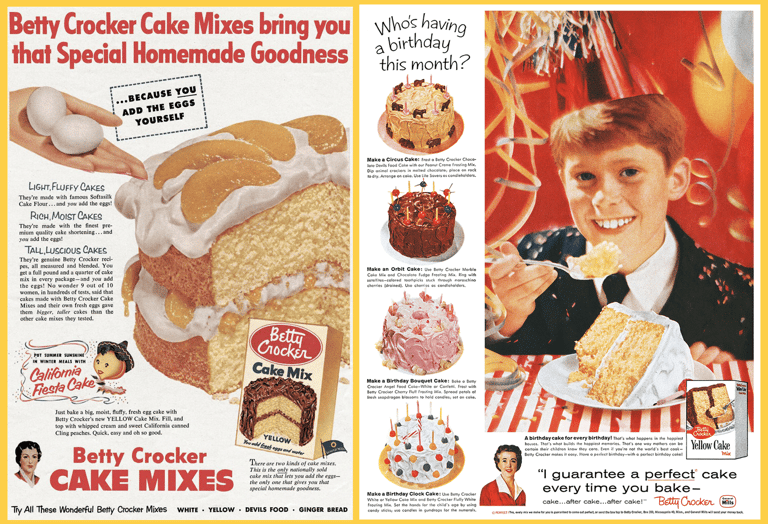
The fix was simple: Betty Crocker removed the powdered eggs, instructing users to "add one fresh egg."
Functionally, nothing changed. The cake was still easy and perfect.
Psychologically, however, the addition was transformative:
Emotional payoff: Homemakers regained pride and ownership
Identity reinforcement: Baking became a visible act of care and competence
Social legitimacy: Sharing the cake restored its meaning as a contribution, not a shortcut
Sales rebounded. Not because the product became harder, but because the experience finally matched consumer expectations.
Why This Lesson Matters Today
This lesson resonates in a world of apps, AI, and hyper-convenient services. Many products today fall into the same trap:
Fully automated tools that remove user contribution
One-click solutions that strip emotional engagement
AI-generated outputs that don't allow personalization or identity expression
Functionality enables usage. But loyalty, attachment, and advocacy come from experiences that meet consumers' expectations for emotion and identity.
Ease is not inherently bad - it's a modifier, not a motivator. The right balance between convenience and meaningful contribution drives adoption, repeat usage, and long-term engagement.
The Market Research Takeaway
Betty Crocker teaches three critical lessons:
Functional perfection is necessary but insufficient. A product can "work" and still fail if the experience doesn't meet expectations.
Emotional payoff and identity matter. Consumers want to feel they contributed, that their role is legitimate.
Ease must be contextual. Some experiences prioritize social and emotional payoff over speed; removing effort entirely can backfire.
Every product is an experience. Success depends on whether that experience aligns with what consumers expect in function, emotion, and identity.
Conclusion: Designing Experiences That Matter
The Betty Crocker story is deceptively simple but powerful. Convenience alone will not build attachment.
To create products that resonate:
Understand the context of the action
Preserve user contribution and social legitimacy
Design for experiences that deliver emotional and identity payoff, not just efficiency
Ease is just one ingredient. Meaningful experiences are the recipe for lasting engagement.
Subscribe to our newsletter
Keep up with the latest in Consumer Insights as we explore new trends, tools, and discoveries transforming how we understand consumers.
Connect
© 2025. All rights reserved.